Thursday, 12 February 2009

Autobiography of a sex worker: Nalina Jameela


I have just finished reading a fascinating book, ’Autobiography of a sex worker’ by Nalini Jameela. 


Nalini Jameela (50) holds her book 'The Autobiography of a Sex Worker' in the southern Indian state of Kerala December 14, 2005. Her long, wavy, black hair tied loosely in a knot, Jameela looks like any other Indian housewife. But this attractive, largely uneducated mother of two is a best-selling author and prostitute whose outspoken views of sex work as an ordinary career choice have stirred controversy in conservative India. [Reuters]


“I am Nalini. Was born at Kalloor near Amballoor. I am forty-nine years old.” When Nalini Jameela wrote the first sentences of her autobiography in a notebook in 2003, a client who chanced to read these lines left her — not out of fear of exposure, but because she had told him she was only 42!

When the autobiography finally appeared in print two years later, in Malayalam, it sold like hot cakes. In J. Devika’s English translation of the revised memoir, Jameela speaks as a sex worker, a description deliberately defined by her profession.

I wanted insight into the lives of some of the people I have seen in Pune and in Kolkatta. I have met children of sex workers, many HIV+ve in various orphanages, in the Alpha Village, in Satvana, in Bethesda, all desperately seeking love and affection . I was also struck by the movie I saw (Zindagi break the cycle Timothy Giakwad) which portrays sex trafficking of a young teenage girl. What is life like for these women? So when I saw the book in Hyderabad Airport I picked it up. It was an opportunity to read a real story of one such woman.

What is fascinating is the total 'otherness' of her life situation  and the experiences she goes through. She is a Malayalam speaking woman of a similar age to me, but totally different circumstances. She describes a chaotic, unstable, a ‘perchance’ sort of lifestyle wandering from opportunity to disasters, tossed about by people who variously use her and abuse her. At different seasons of her life a labourer in a clay mine, a wife and mother, a business woman, a sex-worker, a social activist and filmmaker, a political speaker and writer. She appears to drift between worlds and describes it all naturally without much polish.

She starts life a Hindu and marries a Muslim. It was particularly fascinating to read of the twilight zone surrounding mosques where she sought refuge at various low points in her life. One particular concern is protecting he honour of her daughter. Her greatest challenge is how to provide for and nurture her offspring without the normal social convention of a male protector.

It is disturbing in that it brings into the public arena what is so often swept under the carpet, it gives voice to sex workers. It even defines language which is more acceptable. It is controversial in that it gave voice to women sex workers through one of the community who has spoken out and told it as it is. Some accuse her of being too outspoken.

Sex worker are free in four respects. We don't have to cook for a husband; we don't have to wash his dirty clothes; we don't have to ask for his permission to raise our kids as we deem fit; we don't have to run after a husband claiming rights to his property."


One web based review I read: 
It's not long -- 143 pages -- and its translation doesn't feel right -- but I would say it makes complusory reading.
It is, in many ways a shocking book -- NOT because of what it says about the life of a sex-worker but for what it reveals about the lives of so-called "ordinary" Indians. ….. Jameela's story is one of extraordinary resilience - Against the backdrop of Jameela's account, however, "ordinary" and "extraordinary" cease to have much meaning -- she shows us that the huge majority of "ordinary" people have "extraordinary" experiences, in which case they are no longer extraordinary in the sense of unusual, but merely the norm –--- Jameela's life and the lives of the huge majority of those amongst whom she lives -- not just sex-workers, but the tradesmen, the rickshawallas, the policemen, the small hoteliers -- are marked by unrelenting insecurity, hampered by such extremes of heartlessness that it is really difficult to understand how they can bear to face up to their realities –
The Malayalam edition of her book was snapped up -- 13,000 copies were sold in the first 100 days, according to the introduction of this book. It is not a salacious book -- no-one reading it, I believe, is likely to get any cheap thrills from it. To some extent, I miss the spice that has been (I think deliberately) left out.
How ironic that less provocative books -- lacy fictions built on middle-aged fantasies -- are decked out like scarlet ladies, while this one, about and by a scarlet lady, looks as meek and saintly as a vegetarian recipe book!


See also related article in China Daily,  Dec 05  Indian prostitute mum sparks storm with book


Wednesday, 11 February 2009

The Sorrow of Christ - K.C.S. Paniker


The Sorrow of Christ

Masao Takenaka writes 

‘One of the most appealing artistic pieces I saw in India was by K.C.S. Paniker . It is called the Sorrow of Christ Pakiker was a noted Indian artist and art teacher. In 1957 he became principal of the Government College of Ats and Crafts in Madras. After his retirement he helped organise a village of young artists, outside Madras city at a place called Cholamondal. I remember visiting him there. I took a jeep from Madras. It was a hot day and the road was dusty. It took almost two hours to reach the place. Paniker, white-bearded welcomed me. He was at that time 62 years old. 

He took me to his studio and showed me his sculpture called ‘The Sorrow of Christ’ I asked him: ‘Tell me, what led you to do this work?. He said “ I am a Hindu. We contemplate and pray and fast. We meditate on the way of compassion. I read the Bible at Madras Christian College, where I studied. I was impressed to find that this man, Jesus of Nazareth, not only prayed for, but actually related himself to the misery of marginalised people, such as those who suffered from leprosy.”


The sculpture vividly shows the compassion of Christ, identifying with the misery of suffering people. His nose is distorted. His mouth is misshapen and his eyes pop out. I thought the Christ, of the mis-shapen nose and his eyes pop out. I thought this Christ, of the misshapen nose if one of the most penetrating images of Christ in Asia where the physical condition of leprosy and the social status of the outcast are still a part of our existential reality.’  


Masao Takenaka 'God is Rice: Asian culture and Christian Faith'  WCC 1986 p 35-36


Tuesday, 10 February 2009

Hijra of Pune February 2009


Penna, Stella and Koelli talking with Dr Lalita 


I visited ‘Budwar Pet’ Red Light district in Pune with Dr Lalita. We walked to the Satvana crèche run for children of sex workers every week day from 5:30 – 9:30 for the last couple of years. They weren’t there but it gave us space to talk (in hindi/urdu). Being able to communicate makes all the difference. It gets beyond the superficial, the outward appearance of things. Dr Lalita calls the Hijra ‘her special people.’

I met Panna who runs the crèche, Koelli from Keralla who has been in Pune for the last 25 years and Stella from Tamil Nadu for the past 20. All three have come out of the trade. As we talked they gave a demonstration dance and Penen sang a song: ‘Koi bhi chore mujhe, Yesu kebhi nehin chorega’ (even if others leave me, Jesus will never leave me)

Dr Laita stared working at Jadhav Natva Sansar and befriending the hijra or 'kinnar' (eunuchs). It was a real lesson in acceptance. Dr Laita has befriended and served them, demonstrating unconditional love. They are now in turn helping others. They all seem to call her ‘uma’ (mum) or ‘aunty’

We went on a walkabout the streets. Narrow dirty lanes, full of shops, DVD stalls, narrow lanes and gullies. People milling around.  Penna and the others greeted men and women and fellow ‘kinnar’ and the mamas sitting outside the doors. Everyone eyes everyone else up.
At night it is the twilight world of TGs (transgenders) FSWs (female sex workers) and MSMs (men having sex with men).  In the heat of the day, the home spills out onto the street, difficult to discern private and public, domestic and professional.    I was concerned about girls not much older than my daughter. So much exploitation. 
 
In her small one room flat over a cuppa ‘germ chai’, Penna showed me pictures of her heyday, her dancing days. With all her make up, she looked like a Greta Garbo figure from Hollywood. Then she earned 10,000 Rs a night dancing. But she wouldn’t swap those days for now anytime. Now she has a sense of peace and purpose.


Penna quoted by heart Isaiah 56: 4-5 in Hindi - verses that mean so much to her: 
'For this is what the LORD says: “To the eunuchs who keep my Sabbaths, who choose what pleases me and hold fast to my covenant to them I will give within my temple and its walls a memorial and a name better than sons and daughters; I will give them an everlasting name that will not be cut off.’

Monday, 9 February 2009

Bush fires in Australia - news from a freind

A wildfire rages in Healesville in Australia

I received the following from a good Aussie friend  Warwick 
It makes the reality of the Bush fires come alive 

I have never seen anything like it in my life. The temperature was 48 Celcius, the winds were gusting at 80 - 90 MPH.

Whole towns have literally been wiped from the map. The toll so far is 108 confirmed dead but that is expected to grow as police get to sift through the debris.

We are aware of 2 Christian rehab centres caught in the fires. One was only opened last year by a group called Betel. They had bought a former guest house in Marysville and had a small team in place and 6 residents in the program. The fire came at such pace that they only had time to climb into cars and escape with what they were wearing. In the confusion I am informed that one female member of their team is missing. Their whole centre is just ashes today. One of the leaders who is based in Italy is flying home at the moment to assist them. The township of Marysville is no more. The whole town, which has been a very popular tourist centre for over 100 years and only an hour & a half from Melbourne, is gone.

The other place is run by a group called Remar International. Their property is in the middle of dense bush and at this stage we have not been able to contact them at all. All communications in that area are down. Due to the ferocity of the fires in that area we can only presume that their centre will have been destroyed but we will keep trying to find more detail about this group.

It is fair to say that the whole state of Victoria is in shock today. Everyone I have spoken to today has a story to tell about a relative or friend caught up in the fires. Either people missing or dead, or houses burnt to the ground.

Please pray for these situations. The tragedy will be ongoing for many months. Even when rebuilding begins their will be scarred lives struggling to deal with all that they have experienced.
According to the BBC  the fires were started by arsonists and so far 170 lives have been claimed


Sunday, 8 February 2009

God is rice: Masao Takenaka


GOD IS RICE

I am reading the classic book on Asian Spirituality 'God is Rice:  Asian Culture and Christian Faith' by Masao Takenaka (WCC,1986)
I will share some of his insight over a number of blogs because it covers a range of interests in church, culture, mission, art, spirituality. And it connects very much with the search for indigenous, Asian missiology.     The following is an extract:  

Asia is so big and diverse. It is not easy to identify Asia. What we have in common is the habit of eating rice, the ubiquitous bamboo, and the use of broken English as a necessary evil for inter-Asian communication.

We can trace the Silk Road along which silk was transported by horses and camels. We can trace the ceramic route taken by boats. Both were primarily for the rulers and the rich. But we can also trace the rice road, and that was used by common people all over Asia. To be sure there were varieties of rice; what one ate depended on geography and personal preference. Nevertheless, it remains true that rice has been and is our daily food in Asia.
It is appropriate for us therefore to say ‘God is rice’, rather than ‘God is bread.’  Kim Chi-Ha, the well known Korean Christian poet, who was sent to prison several times in the last 10 years (70/80s), has written
Heaven is rice
As we cannot go to heaven alone
We should share rice with one another
As all share the light of the heavenly stars
We should share and eat rice together
Heaven is rice
When we eat and swallow rice
Heaven dwells in our body
Rice is heaven
Yes rice is the matter
We should all eat together


It certainly reminds us of holy communion, which is the occasion to share our daily food together with all people and a symbol of eternal life. This has a social implication as well as a spiritual meaning. The Chinese character for peace(wa) literally means harmony. It derives from two words: one is rice and the other is mouth. It means that unless we share rice together with all people, we will not have peace. When every mouth in the whole inhabited world is filled with daily food then we can have peace on earth.   (p 17-19)


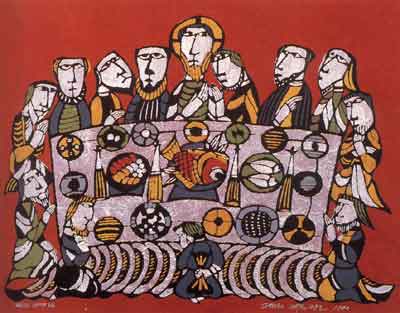
'Last Supper by' Sadao Watanabe


When he was in his mid teens Sadao Watanabe, a well-known Japanese print artist, fist visited a Christian church, introduced by a neighbour who was a school teacher. He had lost his father when he was ten years old, and tended to live a closed and isolated life. He described his first impression of Christianity as follows

'In the beginning I had a negative reaction to Christianity. The atmosphere was full of "the smell of butter", so foreign to the ordinary Japanese'
(Sadao Watanabe - the man and his work by Masao Tekenaka in biblical Prints by Sadao Watanabe 1986)

Now in his print work he joyfully depicts the celebration of the holy communion with sushi, pickled fish and rice, a typical Japanese dish, served on traditional folk art plates. For him rice is a more natural and a more fitting symbol of daily food than bread which is foreign.    (p6-7)

Saturday, 7 February 2009

Zindegi: Break the cycle


Zindegi: Break the cycle   a film by Timothy Gaikwad.  Timothy has produced about 50 films  He showed us this latest 40 min docu-drama whilst on a visit to the Alpha village. 

The plot summary is taken from  Yet another AIDS movie by IMCARES
Zindagi is a story of a 16 year old girl who is trafficked from rural Maharashtra and sold into prostitution in Mumbai. This is a document of Her and many like her who go though this journey through hell. She gives birth to a daughter in the brothels. The little girls too is at the risk of being recruited in this oldest business in the world. Meanwhile certain simple social workers from a nearby church come to her rescue. The daughter is brought-up in a foster home and the mother is reformed. The cycle is broken! But ignorance is bliss. The parallel story shows a fourth generation prostitute. A young male child who is abused by his mother's customers, grows up to be a Hijra and eventually takes over the brothel. No child is safe in the red-light areas be it a male or a female.

There are simple and friendly looking agents lurking in the villages in India, to take advantage of poverty stricken families. They promise domestic jobs for young girls, pay some money to the parents, and then sell the girls in Mumbai's red light areas. This is true. This film contains some bold scenes of torture, post traumatic disorders and the apathy of women and children in prostitution. But above all it gives hope!


And that hope is exemplified by our visit to Alpha village.  A project of IMCARES  (Intermission Care and Rehabilitation Society) based out of Mumbai, where there is a ministry to streetkids.  The village itself is outside Pune and  occupies a plot of land behind an old Anglican Church (now CNI). 

It is not huge by any means, but it is a safe haven.  A smattering of buildings house around 50 boys, who are mainly Aids orphans or come from Mumbai sex workers as well as victoms of the 1993 Latur earthquake in Maharashtra  (there is another home for smaller boys and for Girls)  The 'village' has a small kitchen garden and views of hills around. The sense of care abounds. Lots of smiling faces and happy children playing cricket. 

Timothy Gaikwad is brother-in-law to my CMS colleague Adrian.  He is passionate about his agency Intermission but more about his street-ministry: 
'I am heartbroken and yet challenged to carry out initiatives that will help end this evil practice of child trafficking . We, at Inter-Mission Cares, have recently produced a film on child trafficking called Zindagi — Break the Cycle. Though this ‘A’ certified film (I don’t know for what reason), is suitable for all of India, it is primarily made with the church audience in mind. We attend church every Sunday and warm the pews. We have become so selfish in our worship of God, that we forget that He is a God of the oppressed and of justice. This film is being shown in churches so that we move out of our comfort zones and go out there, raise our voices, expose the trafficking racket, and also, most importantly, accept the oppressed back in society'

You can read more in 'Expressindia' Reeling Life Realities  and in a Tearfund article:  Film brings message of hope.     Intermisison is a part of both  Viva Network and the Micah Network.  The film was supported by Geneva Global   There is even a clip on YOUTube on the making of Zindegi  Just to give you a taster.  You can also watch a clip from another of Timothy's films Masiha Aaya Hain (a Saviour is Come) showiung a Bollywood style dance in a church that is opening its doors to the marginalised.    


Thursday, 5 February 2009

MIzo Mission: 'from head hunters to ... heart seekers'


head hunters of Mizoram  

'Mizoram is one of the smallest states of the Indian Union, situated between Myanmar (Burma) and Bangladesh it is only 21,000 sq km and a population of less than a million (8,91,058 in 2001) God blessed this small state with a fine moderate climate. It is neither too hot in summer nor too cold in the winter. The land is extremely hilly with narrow ridges and valleys.'


It is the scene of an amazing mission story, of a church and a nation changed, an outcome of the Welsh Revival. 
  
‘In the year 1891 Welsh missionary Rev William Williams and a Khasi Missionary named Aitken came to Mizoram to see the possibility of mission work there, but they could not stay long and went back to the Khasi hills. Then he reported the matter to the Welsh Mission. So the Welsh Mission board appointed him to start work in Mizoram. However before he could go to Mizoram he suddenly died. Then in the year 1894 Arthurington Aboriginal Mission, without knowing this development sent two missionaries, Rev J.H.Lorrain and Rev F.W.Savage to start missionary work in Mizoram. Later in the year 1897 the Presbyterian Church of Wales adopted Mizoram as its Mission Field and successfully worked in the whole territory. A series of revivals swept through the entire land from 1906-1945. Within the period of 50 years, the whole Mizo tribes had become Christians. So now the Presbyterian Church of Mizoram has become self-supporting, self-governing and self-propagating. 
It has become a giving church, a praying church, a singing church and a reviving church as well.’ 

From Synod Mission Board report by Rev Lalchhuanmawia, field secretary


Paul Hattaway of Asia Harvest (author of the Heavenly Man) has written more on this phenomena in nearby and more famous Nagaland  in 'From Head Hunters to Church Planters: an amazing spiritual awakening in Nagaland'  (Piquant 2006) 


In Mozoram they went from village to village and shared a simple message ‘Dear friends, you also believe in Jesus Christ’ and the numbers just continued to grow. Now many Mizos are themselves extending the invitiation beyond their borders. Mizoram has more missionaries per capita than anyhwere else int he world. You could say mission is their main export.